Tracks and Background
Unfold to read!
Cover
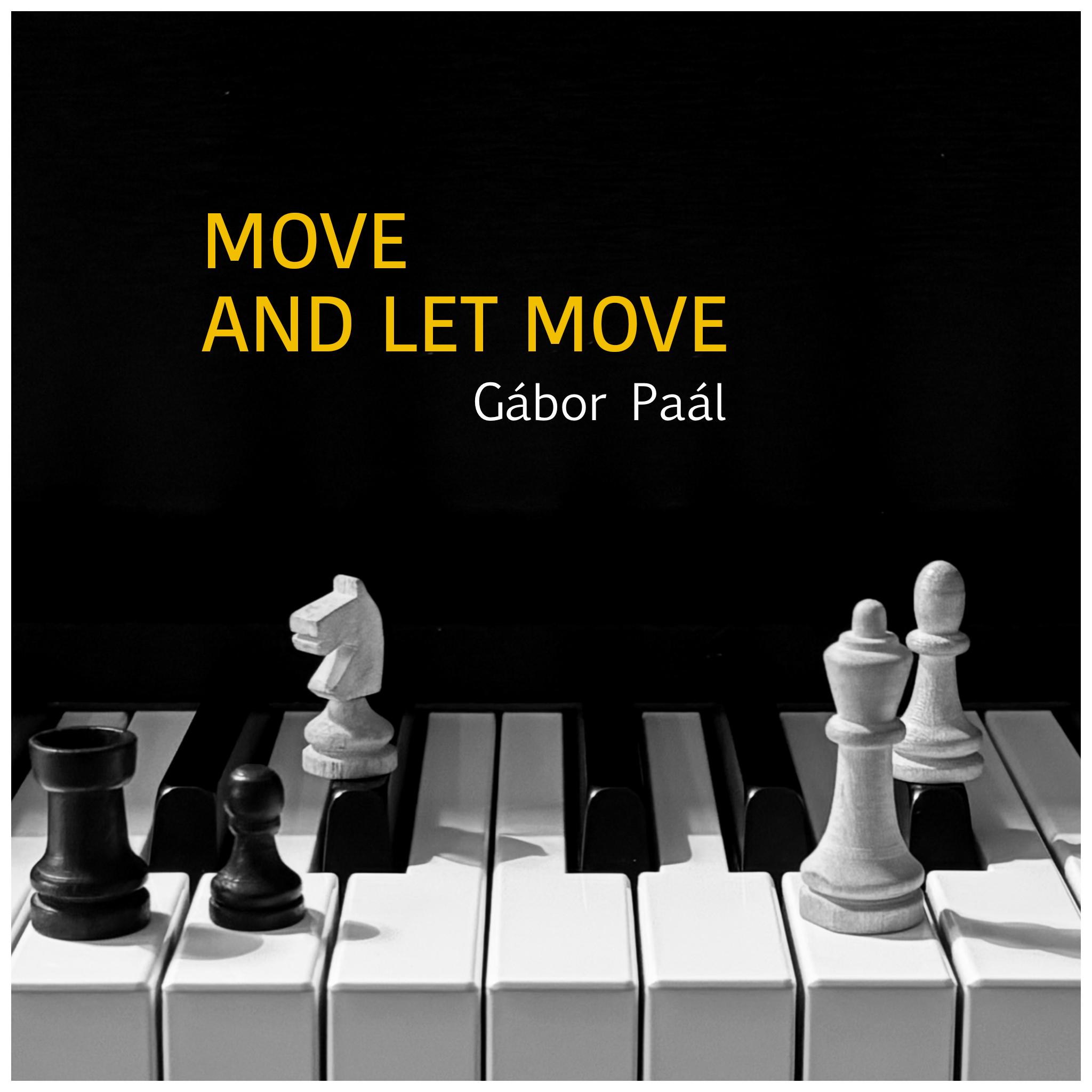
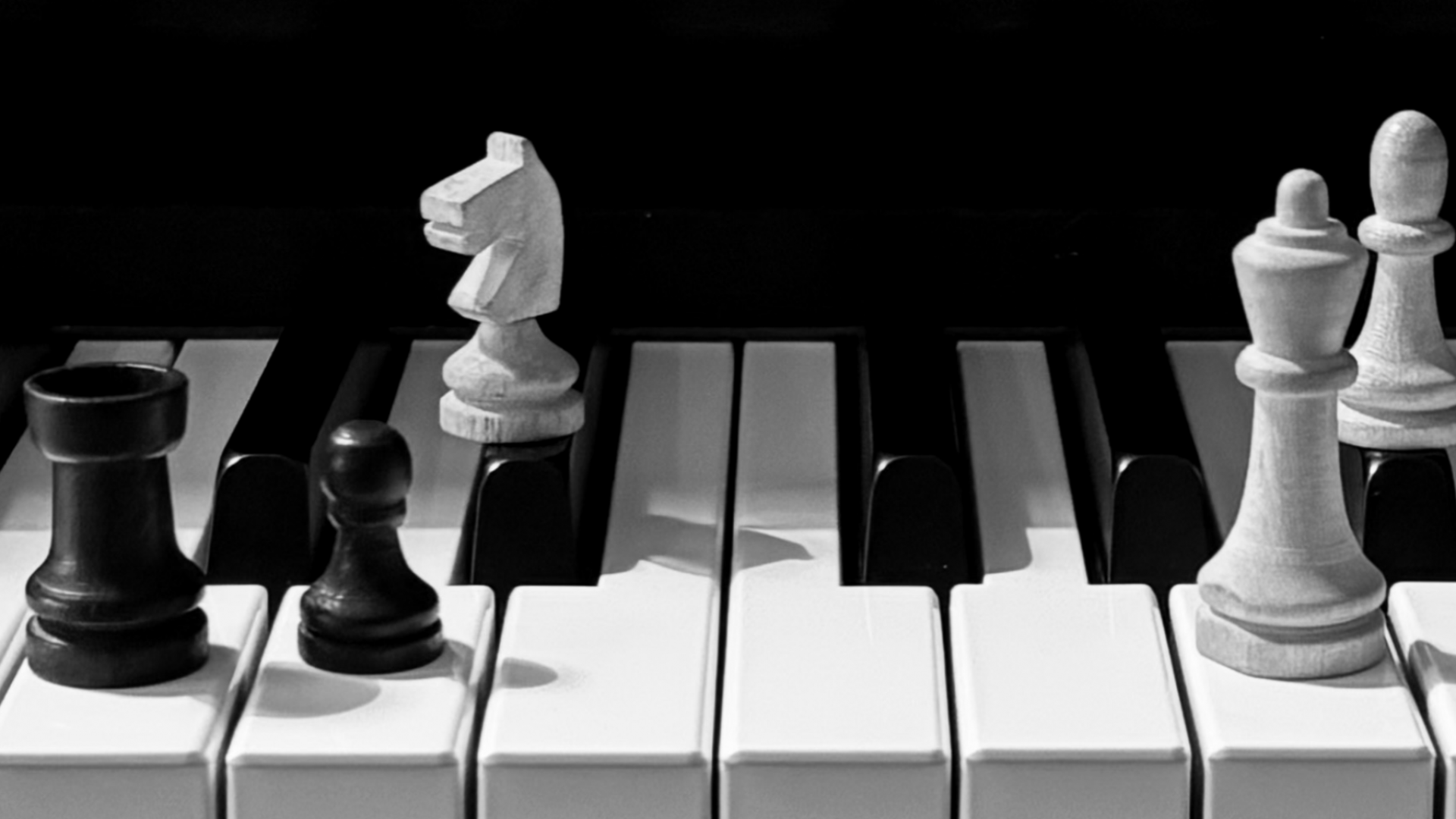
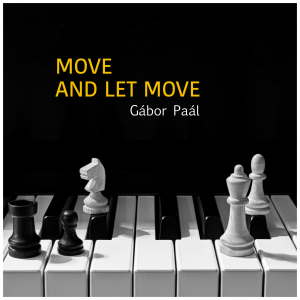
In one of my unpublished poems, I move chess pieces on a keyboard: The rook moves octaves – as on the chessboard – the knight moves minor thirds, and so on. Although I found the idea appealing, it didn’t work as a poem. So I thought it would be better suited as a cover. But it also takes up a variation on my old theme, which is also the subject of my scientific books: the relationship between aesthetics and thinking. Same as my only poetry collection to date (‘Lyrik ist Logik’) – so, chess pieces on a piano keyboard fit well into the series. Thank you, Britta, for the perfectly sized chess set and the final layout.
1 – Opening
This was the last piece to be written for the album. But it’s short, and after the idea for the cover had already been born, I thought: if I open the album with it, at least one piece would contain a reference to chess in its title.
2 – Downstream
I am one of those people who, when standing somewhere with their hands free, tap out certain rhythms. I thought I could derive a piece from one of these rhythms. The rhythm can be found in the first few bars – the rest developed from that.
3 – Human Kindness
In Randy Newman’s ‘I Think It’s Going to Rain Today,’ there is that line ‘Human kindness is overflowing.’ In the third bar, I quote the corresponding melody – E-G-A-C.
When I played the piece to my wife, she said that for her it was like a journey from the cradle to the grave. That’s why I first considered adding ‘cradle to grave’ to the title ‘Human Kindness’.
But I didn’t want to make it too complicated.
4 – Leaving the Harbour
It was actually supposed to be called ‘Harboured’ and be the end of the journey that begins with ‘Downstream’. But then it took on a life of its own. Instead of moving in the safe harbour, the sails are hoisted. The recurring accompanying motif in the left hand is borrowed from the first notes of Bach’s Toccata in E minor.
5 – Excavation
The central motif was created after a trip through south-eastern Anatolia, which took me to the excavations at Göbekli Tepe, among other places.
But Excavation also contains this quiet, playful passage – one of my oldest motifs. I wrote it at the age of 18 for a little boy born at the time. I dug it up again for this piece.
6 – Grand Hotel
My grandfather was a relatively well-known Hungarian journalist and author. In the years between the world wars, he frequently stayed at the legendary Südbahnhotel on the Semmering to interview celebrities. Among other things, he conducted one of the few interviews with Arthur Schnitzler there.
I only found out about this a few years ago from an Austrian literary scholar, Martin Anton Müller, who discovered this interview. Shortly afterwards, I learned that the Südbahnhotel was being renovated. I haven’t managed to visit it yet, but the story has captured my imagination. The piece is a result of this – even if stylistically it doesn’t quite fit into a 1920s dance hall.

7 – Move and Let Move
No story to tell about this one.
8 – Taxi des nos amours
Some day, I noticed that ‘Taxi Driver’ and the chorus of ‘Que reste-t-il des nos amours’ are based on the same harmonic sequence. And I thought I could superimpose them. It was the first piece in which I allowed myself to let my third hand play along at the appropriate moment.

I recorded ‘Taxi des nos amours’ 2023. So it would have been early enough to add it to my first album Frankfurter Rhapsodien, but for some reason I didn’t, although it inspired the ‘yellow cab’ colouring of its cover.
Trailer: